
1A Menton students share family recipes from around the world

Anouk Sethi
For most 1A students arriving at Sciences Po, this is the first time we have had to cook for ourselves. We arrive with pieces of home tucked in our suitcases: spices, salts, foods and ingredients we aren’t sure we’ll find in Menton. I brought Japanese shiso salt and cans of salmon from my local Trader Joe’s in New York City. Some of these things run out in weeks, while others sit in the back of kitchen cabinets for months, saved for the day I truly miss the taste of home. Recipes seem to hold a similar purpose here. At bake sales, I love seeing what people have chosen to make, and I always seem to discover a new international staple. We all come from different backgrounds, and I have enjoyed seeing how we carry them in the foods we cook and share. Many of us miss our home cuisines, but we also love tasting the dishes our friends prepare. So, I asked a few students to share the recipes they carried with them to Menton.
Hungarian Lecsó
“My grandmother doesn’t believe in measurements and neither do I.” - Hanna Hrancár Boroka
Lecsó is a traditional Hungarian dish very similar to shakshuka. Hungarians eat it a lot during the summer. Hanna’s grandma’s philosophy is flexible with no precise measurements. The recipe starts by frying Hungarian sausage (kolbász) in a pan without adding oil, as the sausage is fatty enough on its own. Chopped onions are then added and left to caramelize a little. Next, several tomatoes and peppers are added. In Menton, however, the peppers usually used are not available. So, Hanna suggests you use bell peppers instead. She then advises to let these vegetables cook until they soften. Finally, beat any number of eggs and stir them into the stew. Cook for another 40 to 60 seconds, until the eggs are incorporated.

Pasta Cicciolina
“It’s my absolute favorite dish in the world and reminds me of home always.” - Matteo Heppe
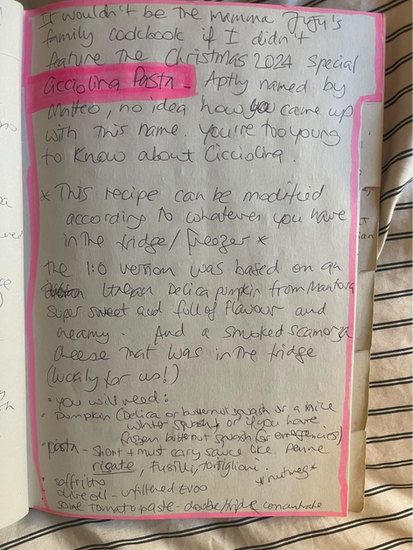
Before coming to Menton, Matteo's mother made him a cookbook filled with the dishes she used to cook for him when he was little. This is one of his absolute favorites: “Pasta Cicciolina,” loosely translated as "pasta of the slightly chubby lady." The name references La Cicciolina, an Italian former porn star turned politician who is quite famous in Italy for her antics. The recipe has Tuscan roots, with influences from the family's life in London. Matteo believes his mother invented this particular version, although many variations exist.
From Mamma Jiji's family cookbook
"It wouldn't be the Mamma Jiji's family cookbook if I didn't feature the Christmas 2024 Special Cicciolina Pasta. Aptly named by Matteo, no idea how you came up with this name. You're too young to know about Cicciolina." — This recipe can be modified according to whatever you have in the fridge/freezer.
"The 1.0 version was based on an Italian Delica pumpkin from Mantova, super sweet and full of flavour and creamy. And a smoked scamorza cheese that was in the fridge (luckily for us!)"
You will need:
• Pumpkin (Delica or butternut squash or a nice winter squash, or if you have frozen butternut squash (for emergencies)
• Pasta – short + must carry sauce like penne rigate, fusilli, tortiglioni
• Soffritto
• Olive oil – unfiltered EVOO
• Some tomato paste – double/triple concentrate
• Nutmeg
• Scamorza affumicata – smoked mozzarella/smoked scamorza
Can make it also with unsmoked, nitrite-free bacon/pancetta (NOT HALAL OBVS) or can add smoked salmon at the end.If you make it with pancetta/bacon cut it and add it to the soffritto for a nice savoury flavour. The salmon you add at the end with the cubed scamorza.
Steps
• On low flame, soften the soffritto (shallot/celery/carrot – or you can use just shallot if you prefer) in olive oil. Can add the unsmoked, nitrite-free bacon now.
• Add the pumpkin cubes (if you have time you can roast the pumpkin before, it really makes the flavour more intense & sweet).
• Add a little water if it's too dry (or white wine – not HALAL!!) and a couple of centimetres of tomato paste from a tube.
• Cook until the pumpkin is all soft + mushy (add salt/pepper to taste).
• Boil the pasta.
• When it's almost ready, drain the pasta (leaving some cooking water to dilute) + pour it into the pumpkin sauce.
• Let the pasta finish cooking + absorb the flavour of the sauce, stirring.
Fold in the cubed scamorza (you were supposed to cube it earlier while the pasta was cooking).
• The scamorza will melt and get all stringy and steamy.
• If you didn't add the bacon at the start you could add some smoked salmon but it's not necessary.
• Add some grated nutmeg (pro-touch to get edge off the cheesiness).
• Can also add some parmigiano if you don't have salmon/bacon.
EAT STRAIGHT AWAY!



Jewish Challah
“The recipe is (now was) a secret family recipe.” - Omi Roll
Omi’s family recipe for Jewish challah bread is (now was) a secret family recipe, although she believes that these recipes all resemble each other. Many people know the classic Jewish challah bread enjoyed every Friday night — typically 2 long braided loaves. Omi loves those! According to her, it is a unique bread that is similar to brioche if she had to compare, but this recipe is for a special version. She and her family only bake it once a year, for Rosh Hashanah, the Jewish New Year. What makes this bread unique is the addition of honey, and its round shape. These hold a particular symbol. The honey is so that the year will be sweet, and filled with good luck. It is round because it is meant to symbolize the passage of time, and the cyclical nature of life (one year ends for another to begin).
The hole in the center is a little less common, but Omi’s family always does it because then, once baked, they place a small bowl with more honey so that they can dip the bread into it after the prayer. This is especially a big deal because usually on Fridays they dip it into salt, so the honey is sort of a reward to start the year off well.
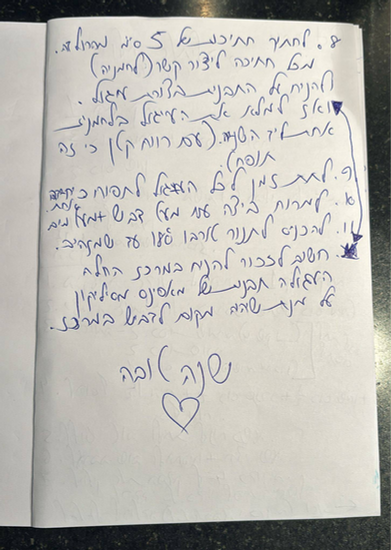
Translated from picture:
Round Challah (Rosh Hashanah)
October 2024
Ingredients:
• 1 kg flour
• ¾ cup sugar + 2 tbsp sugar
• ½ cup oil
• 2 tbsp dry yeast (4 packets of 7 g)
• 1 tbsp salt
• 1 + 1½ cups lukewarm tap water (2½ cups total, used in two stages)
Method
1. Put the 1 kg of flour in a large bowl suitable for rising.
2. Make a large well in the center, big enough to hold a cup of water.
3. Into the well, add 2 tbsp yeast (4 packets), 2 tbsp sugar, and 1 cup lukewarm tap water. Let it foam.
4. Add 1½ cups water, ¾ cup sugar, ½ cup oil, and 1 tbsp salt.
5. Knead, then let it rest for about an hour.
6. Knead again and let it rise for another half hour.
7. Divide the dough into 4 balls. Roll each ball out into a large flat round, then roll each one up into a log, like a roulade.
8. Cut the logs into 5 cm pieces and tie each piece into a knot (a small roll). Arrange the knots in a circle, then fill the circle with more knots placed side by side. Leave small gaps between them because the dough rises.
Important: Put a silicone muffin cup in the center of the circle before filling it in, so there will be a space for honey in the middle.
9. Let the whole circle rise in the pan. (A small word here is unclear. It may say "about half an hour.")
10. Brush with egg mixed with a little honey and a little water.
11. Bake in an oven at 180°C until golden.
Shana Tova




Spanish Tortilla
“If your tortilla recipe doesn't include onions, abstain from calling it tortilla or calling yourself Spanish.” - Hiba Lagraiche El Hallaoui
Onions are the fundamental ingredient, even more important than potatoes, so note that every recipe that doesn't include onions is fake and harmful.
Simple tortilla recipe:
• Boil approximately 3-4 potatoes after washing them thoroughly to remove dirt. Once boiled and soft on the inside (not too soft because they will complete the cooking process in the pan), peel and cut in small dices or mash (depends on preferences)
• For a big tortilla serving (family-size), add 8 eggs to the mashed/diced potatoes
• Add half a teaspoon of salt if you've boiled the potatoes with salt already
• Chop half an onion (or more, depending on how much you like onions) in fine dices or larger ones and add to the mix
• Mix until the eggs mix with the potatoes but don't mix too much so the eggs still preserve their consistency and solidify the tortilla
• Cover the pan in olive oil and throw the mix in it
• Stir the borders of the tortilla and move the mix at the center of the pan to make sure the potatoes are hot and well cooked
• Cover the pan with a large plate and flip it so you can put the tortilla back in the uncooked side
• The approximate cooking time depends on one's personal preferences, if you like solid, dry tortilla, I would recommend keeping it on the pan for ~2 minutes max medium fire, if you like the inside of the tortilla more liquid or raw, cook for ~1 minute

Photo Source: Anouk Sethi, Wikimedia commons, Wikimedia commons