
By Pau Carbonell
November 30, 2022
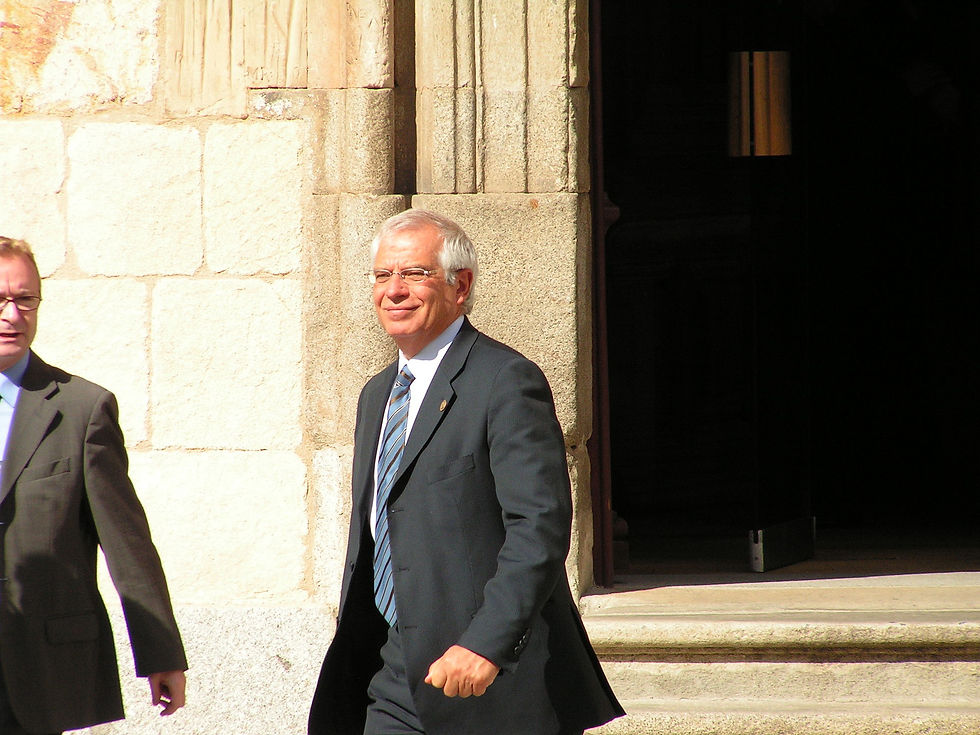
Things are not going well for the European Union High Foreign Affairs Representative Josep Borrell. After delivering one of the worst diplomatic speeches of recent years, Borrell remained stoic amid the flurry of criticism that has fallen upon him in the European Parliament. On Oct. 13, Borrell made Eurocentric and inauspicious statements during his inauguration of the new European Diplomatic Academy in Brussels. His opening speech was supposed to encourage European diplomats to act with humility and respect towards global denizens. Instead, he communicated the opposite message:
“Europe is a garden… Most of the rest of the world is a jungle, and the jungle could invade the garden… Keep the garden, be good gardeners. But your duty will not be to take care of the garden itself but [of] the jungle outside… they will not protect the garden by building walls. A nice small garden surrounded by high walls in order to prevent the jungle from coming in is not going to be a solution. Because the jungle has a strong growth capacity, and the wall will never be high enough in order to protect the garden.”
Even as Borrell was delivering his speech tinged with racist and imperialist overtones, people in the audience felt uncomfortable, realizing how such a metaphor would damage European diplomacy. The fact is that his remarks mirror the age-old distinction between European “civilization” and the “barbaric” lands beyond. Since the 19th and 20th centuries, the garden analogy has been used by writers like John Stuart Mill and Alexis de Tocqueville to justify global European colonization and temper resistance to expansionist sentiment. The danger of Borrell’s speech lies in the reappearance of neo-colonial rhetoric in a century wherein Europe’s foreign policy is officially committed to aiding postcolonial economies and institutions.
The implications of this speech are not and should not be diminished in the scope of their importance. In the modern world, people and nations are constantly listening and Borrell’s words have been heard worldwide. Apart from harsh criticisms of the speech spouted by politicians, journalists and columnists globally, Borrell has alienated European allies and strengthened its enemies. The United Arab Emirates summoned the interim head of the European Union mission in the country, Emil Paulsen, to discuss the “racist” inauguration and Russia’s Minister of Foreign Affairs Sergei Lavrov said that “the garden Borrell talks about was built by plundering the jungle of the rest of the world during the colonial regime.”
A piece in The New York Times has best summarized the gravity of the situation. Matina Stevis-Gridneff reported that Josep Borrell’s comments opened colonial wounds at a time when the European Union was working on ameliorating its legacy internationally. But this new scandal should not surprise those knowledgeable about European affairs — Borrell, who has served in his role since December 2019, has been involved in numerous diplomatic scandals during his tenure. Yet, this was a new low. With an ever-expanding divergence between the Central European and Eastern European member states, tense global multipolar outlooks and, in particular, Russia’s Ukrainian invasion, European policy cannot afford this type of discourse. Borrell’s paternalistic smugness, vainness, conceit and supremacism will hinder Europe from reinforcing old alliances or forging new ones.
In her work “The European Union, Foreign Policy in a Changing World,” London School of Economics professor Karen E. Smith asserts that the European Union should pursue three foreign policy objectives if it wants to remain a global superpower. Firstly it must encourage regional cooperation and integration. Secondly, it should promote human rights. Thirdly, the union ought to bolster democracy and good governance. According to Smith, these factors are important since they all legitimize the European Union’s instruments to leverage in future international economic, diplomatic or military relations.
Niccolò Machiavelli’s quote, “politics have no relation to morals,” does not seem to resonate with 21st-century European foreign policy — at least not nominally. Europe can only operate so long as it remains legitimate in the eyes of the governed. The notions of cooperation, integration, democracy, good governance and human rights included in the 1993 Maastricht Treaty demonstrate how union leaders have embraced the issues that its citizens seem to find important. That is precisely why Borrell’s speech is surprising — it is not only the type of discourse that Europe has been feverishly trying to avoid since the advent of unipolarity in the post-Cold War era, but because it was the face of European Foreign Policy, who said it.
This blunder is representative of two situations that could be surfacing in the department of European Foreign Affairs. On the one hand, one could hypothetically consider this statement as merely the personal opinion of Josep Borrell. On the other hand, one could interpret it as a damning glimpse into the ideological core of European foreign policy. I hope that reality is closer to the former of the two explanations.
Borrell’s garden allegory adds to a lengthening laundry list of statements showcasing the unmodern outlooks of European foreign policy movers and shakers. It is indicative of the growing feeling of wonder and uncertainty as to how Europe plans to face the increasing challenges of modernity in a time where once again, war, violence and division are on the rise.