
Ibtissem Remdane
September 16, 2026
Women in Somalia are majorly described through the language of weakness: conflict, displacement, violence and loss. Somalian women make up 49.9% of Somalia’s total population. The country ranks among the worst for women’s rights, with a UNDP Gender Inequality Index score of 0.776, where a score of 1 indicates complete gender inequality. Furthermore, a startling 99 percent of women between the ages of 15 and 49 years have undergone Female Genital Mutilation (FGM).
All of these realities are undisputable, and for many women, especially those living in displacement camps, they shape everyday life. Yet this framing, while alarmingly accurate, is incomplete: it captures what is done to these women, not how they respond to it. It reduces their lived experience to suffering alone, overlooking the many forms of agency they cling to, their organization and leadership that persist even in the most fragile of conditions.
In displacement camps, life is governed by uncertainty. Families arrive after fleeing drought or war zones, only to find spaces that offer limited protection and scarce resources. For these women, this instability translates into a constant negotiation for survival. Each day begins with urgent, practical questions: how to access water, how to feed children, how to secure small amounts of income, how to maintain safety in spaces where privacy is minimal and protection is inadequate.
The risks are particularly acute and routine tasks such as collecting firewood or fetching water expose women and girls to harassment and violence. Overcrowding, weak infrastructure and limited access to healthcare actively deepens that vulnerability. Moreover, the economic pressure forces difficult choices, sometimes pushing families toward early marriage for daughters or precarious forms of labor.
Yet focusing solely on vulnerability obscures an important truth: women are the ones who make survival possible. Within camps, they are the ones rationing food supplies, caring for children, and attempting to find stability when there has been none since 1991. This work is constant and demanding, but is rarely recognized as such. It is dismissed and reduced as background even though it underpins every aspect of the daily lives in these camps.
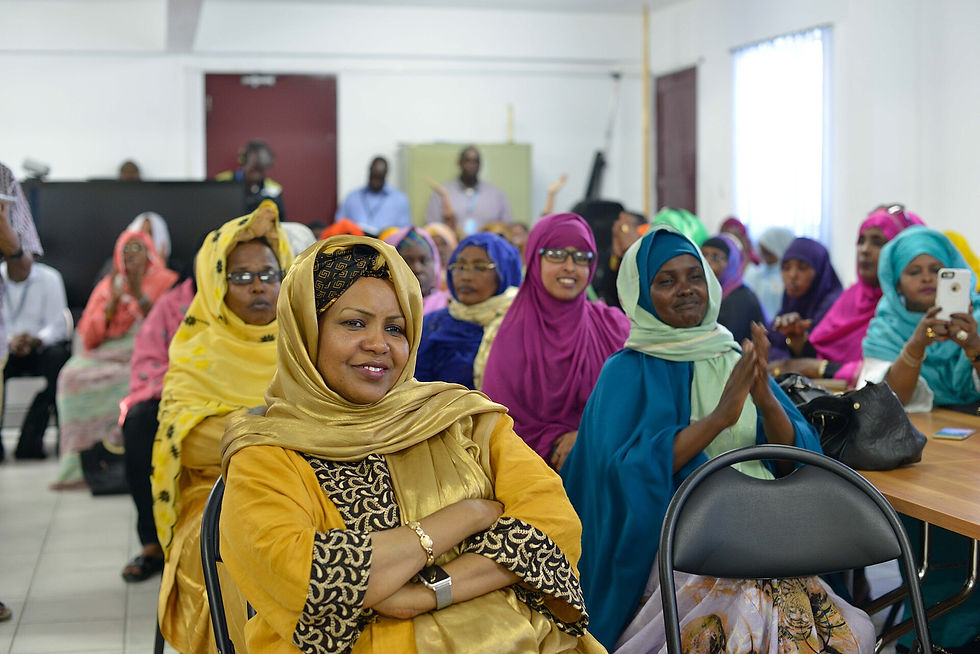
Beyond individual households, women also act collectively, which is where their strength lies. In many camps, they build informal networks that sustain entire communities. These networks are practical and immediate, again, sharing food, rotating childcare, exchanging information and offering emotional support. They are not the formal institutions which were promised to them for protection, and they remain invisible in official accounts, but still they are essential. When those formal systems fail, it is these structures of solidarity that fill the gap. They demonstrate a form of social organization that is both adaptive and incredibly resilient.
This collective dimension challenges the claim of passivity often associated with certain humanitarian narratives attributed to women in Somalia. They are not simply the recipients of aid, they are active participants trying to rebuild their country. While organizing around necessity, they at the same time respond to gaps in services and develop systems that allow families to endure. Their agency, in this context, does not mean freedom from constraint. It means acting within these very constraints and making decisions, however limited, that influence outcomes for themselves and others.
There is also a broader political dimension to women’s roles in Somali society. As even when excluded from formal positions of power, they have long contributed to community mediation and peacebuilding. Especially in local disputes where they commonly help to maintain dialogue or reduce tensions. By championing cohesion across certain families and clans, writing about Somalia or advocating for it, their influence is unofficial but significant. Displacement camps are not isolated spaces, they are embedded within wider social and political dynamics. And the same women managing daily survival are also participants in these larger processes of negotiation and stability.
One of the most persistent challenges in writing about women in Somalia is the issue of visibility. Even finding enough resources to write this article proved tricky. The facts are acknowledged and talked about extensively, but more often than not without centering their own trauma and voices. Their leadership is evident in practice, but rarely recognized as political. This gap between reality and representation conditions how their experiences are understood, and therefore, misunderstood.
A more accurate account must therefore hold two truths simultaneously. Women in Somalia face serious and devastatingly brutal forms of violence, displacement and have to live with longstanding grievances. It hinders any choices they could ever make, and creates an ever-present system of ongoing harm. But the most important point there is to emphasize is that within these constraints Somali women are not passive. They act, organize, react and lead. Yes, their agency may be constrained, informal or unrecognized, but it is nonetheless very real.
This dual reality is especially visible in the displacement camps and local communities in Somalia. They are spaces of hardship but also of social persistence. Again, these women hold communities together, sustain networks of support and care and create forms of order where little exists. They do not simply endure crisis, they shape how it is lived.
Writing about women in Somalia in this way does not diminish the severity of the challenges they face. Rather, it tries to provide a fuller picture, one that recognizes not only vulnerability but also tenacity. Not only loss but also the capacity to respond. It is an active survival where agency exists not despite crisis, but intrinsically and fervently within it.
Photo Source: Ilyas Ahmed